


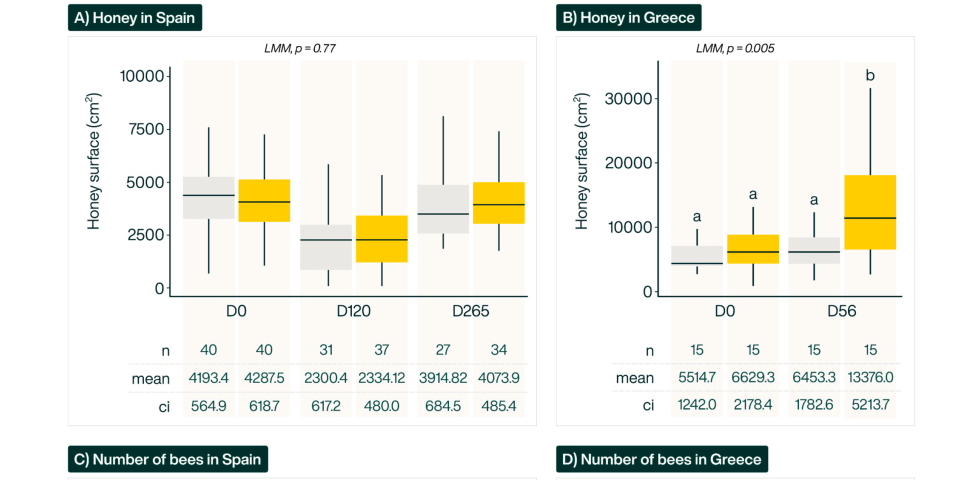
Nutrition is key to improve honey bees’ resilience to environmental stress factors that threaten their health. Yet, little is known about the micronutritional needs of colonies, in particular about molybdenum, an essential trace element in biology. This study focuses on a coordination complex based on molybdenum Mo(+V) which was assessed for compatibility with standard beekeeping practices. It was found to be non-toxic for bees, stable and easy to use. Importantly, it does not leave any residues in honey produced. This study investigated how sup plementation with few milligrams of this complex can improve hive performance at early spring and reduce winter mortality. Over a two-year field campaign, 283 beehives spread over 6 apiaries located in Spain, Greece and France were involved. A significant increase in honey reserves within the brood area of 107% was observed in the Greek apiary, whereas no comparable effect was detected in Spain, suggesting that local envi ronmental conditions or management practices may influence this parameter. This study highlights the impor tance of molybdenum in the management of honey bees as an efficient tool to reduce the winter mortality of the colonies.
Reducing honey bee winter mortality with molybdenum supplementation: Field evidence across Europe