


New paper (Open Access): We evaluated whether emergency use of thiamethoxam (TMX) seed treatments in non-flowering sugar beet (Germany, 2021) translated into measurable effects on honey bee colony performance under field-relevant agricultural conditions.
Why this study?
Neonicotinoids are restricted in the EU due to concerns about pollinator health, yet thiamethoxam was authorized for sugar beet cultivation via emergency use. Although sugar beet does not flower during the cultivation year, indirect exposure of honey bees may still occur through flowering weeds within fields, field margins, or surrounding landscapes, as well as via environmental matrices.
This study therefore aimed to move beyond exposure estimates alone and assess whether such low, field-realistic exposures translate into detectable biological effects at the colony and individual level.
What we did
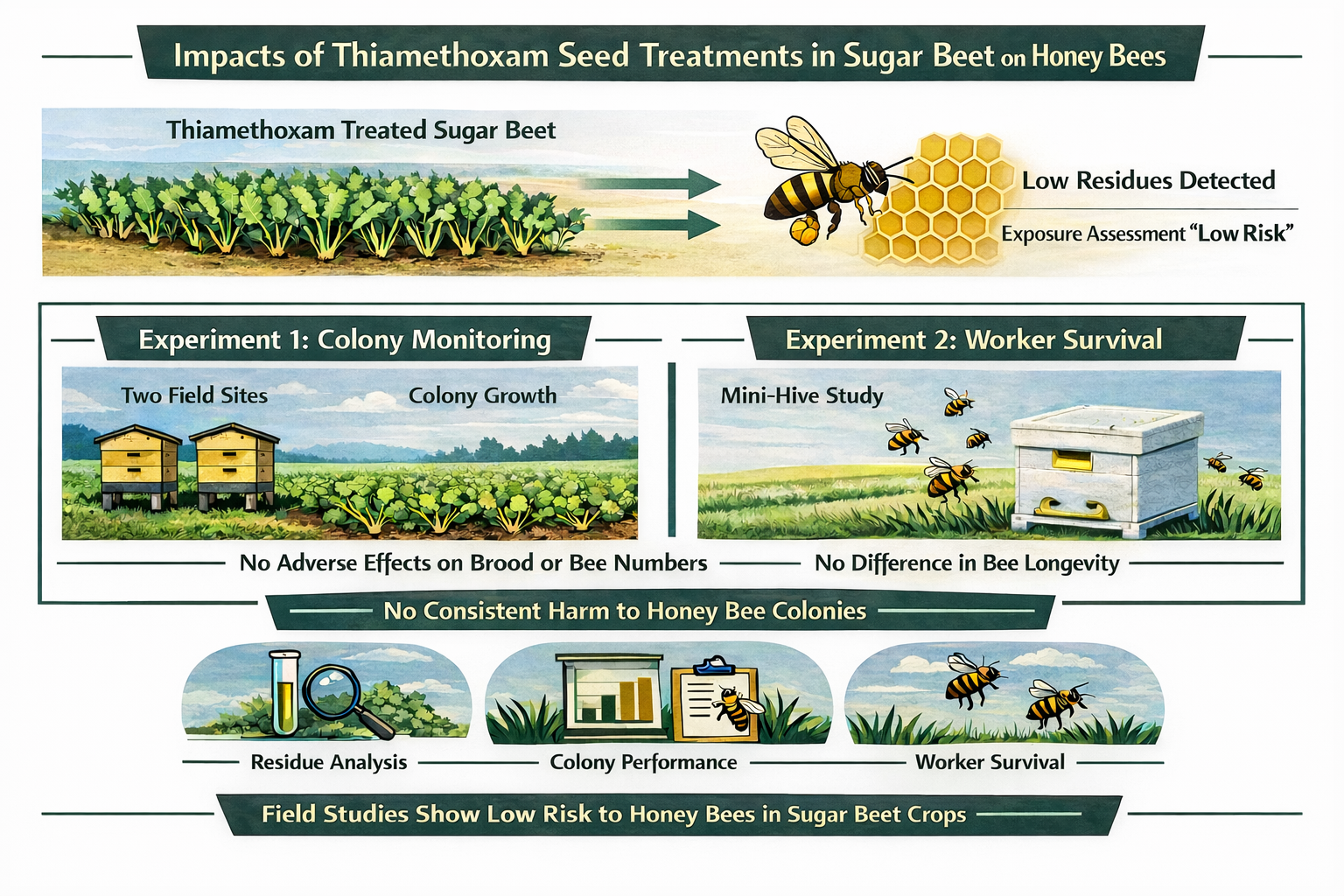
- Experiment 1 (field colonies): Full-sized honey bee colonies were monitored at two geographically distinct sites throughout the 2021 sugar beet season, focusing on adult bee populations and brood cell numbers.
- Experiment 2 (mini-hives): Worker survival was quantified using free-flying mini-hives, analysed with mixed-effects Cox models accounting for colony-level variance.
- Exposure context: Residues in bee-relevant matrices were detected only at very low concentrations, and conservative exposure modelling indicated no acute or chronic risk for honey bees.
Key findings
- No consistent adverse effects of thiamethoxam treatment on colony strength or brood development were detected across sites.
- Survival analyses revealed no evidence for reduced worker longevity under the tested field-relevant neonicotinoid exposure scenario.
- Taken together, the results indicate a low apparent risk to honey bee colony health under the studied agricultural conditions, while underlining the importance of multi-site and longer-term field evaluations in pesticide risk assessment.
Full article: https://doi.org/10.1002/ece3.72767