


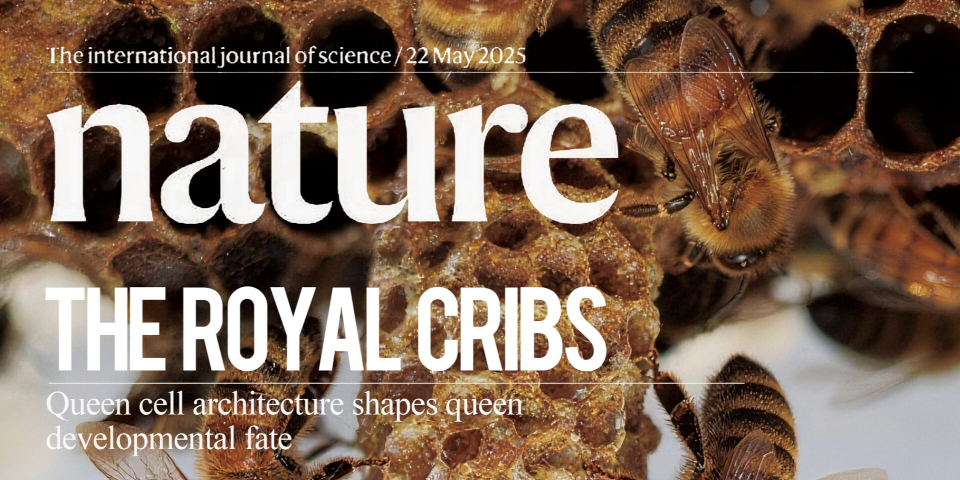
Nest architecture in social insects is often viewed as a static structural component providing shelter or storage. However, the extent to which these constructed environments actively shape biological traits remains poorly understood. Although the genetic and nutritional drivers of honey bee caste determination are well established, the role for specialized queen cells has largely been attributed to spatial or structural factors, overlooking the influence of the physicochemical microenvironment. Here we show that worker construction behaviour actively engineers a physicochemical niche that is crucial for queen development in honey bees. Queen cells exhibit distinct mechanical and chemical signatures that differ markedly from those of worker cells. These properties are not an accidental by-product of worker cell construction: workers construct queen cells deliberately and, in doing so, undergo task-specific physiological and transcriptomic reprogramming that enables precise engineering of these cell properties. Experimental manipulations of the rearing environment demonstrate that these physicochemical cues are causally required for normal queen development, functioning as a critical checkpoint that can profoundly influence an individual larva’s development. Together, our results establish a direct mechanistic link between social construction behaviour and developmental plasticity, revealing how an engineered environment can channel organismal fate..
2496 Members
127 Countries!
127 Countries!